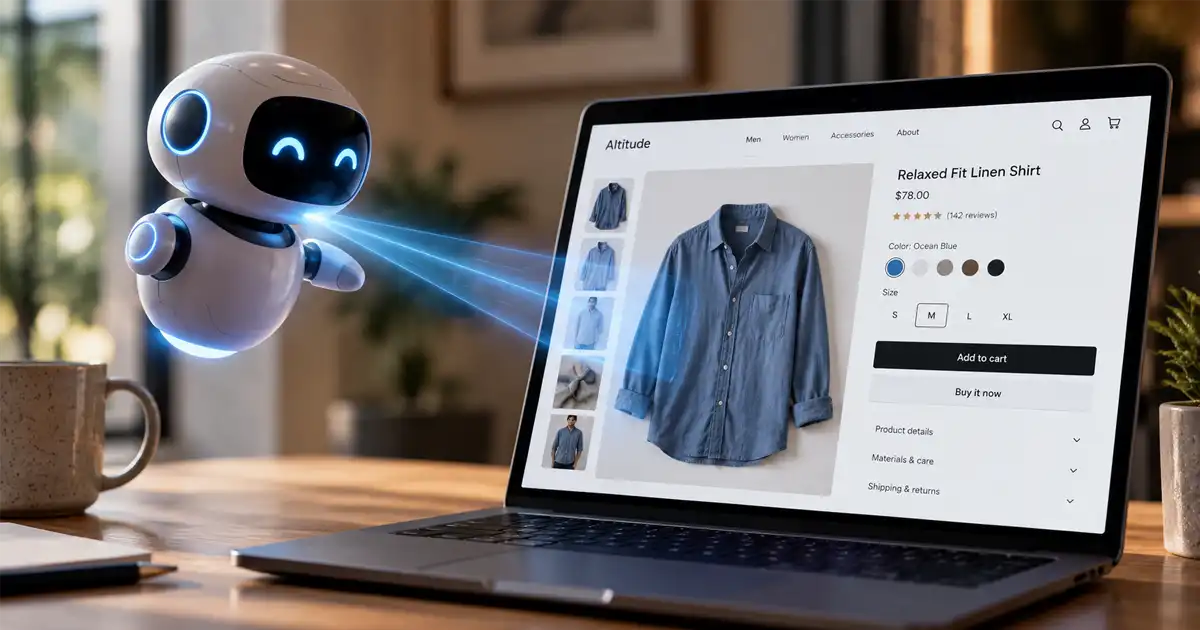
AI shopping agents have opinions about your product, and they've now been studied. In 11,307 test runs, price was the top reason an agent picked a product, reviews were second, and brand name came up in fewer than 1% of picks. Price often gets decided by the shopper's budget before your listing is even considered, so reviews end up being the factor you control most.
So look at your product detail pages (PDPs) with two questions in mind. Do you have enough reviews? And can an agent find them and read them?
What a16z Tested
a16z partners Olivia Moore and Justine Moore published a16z's study of how AI agents buy, titled "Welcome to the B2A Economy: How Agents Buy," on November 23, 2026. It follows their November 10 essay, which argued that AI agents are turning into a customer segment of their own.
B2A stands for business-to-agent. Software makes the buying decision, or most of it, for a human shopper. It goes further than GEO (Generative Engine Optimization). In a16z's view, GEO largely stops at discovery, while agents keep going: they compare the options and complete the purchase.
Working with The Prompting Company, the authors ran 11,307 shopping and software tests on four consumer agents: Meta's Muse, Grok Bot, Instinct and Dots. The prompts sounded like ordinary shoppers, such as "find me noise-canceling headphones under $150." They then compared the results with YipitData spending data to see where agents already spend money.
A note on sources: The Prompting Company sells agent-readiness services, so it benefits when brands take these results seriously. The data is still useful. Just keep that in mind as you read it.
Price Comes First, and You Often Can't Change That
Price was the most-cited reason for a pick, at 43%. Reviews came next at 30%. After that came in-stock status (15%), refunds (6%) and delivery (5%). Brand name appeared in under 1% of picks. Years of logo work counted for about as much as the font on your shipping label.
When a shopper says "under $150," that budget becomes the price filter. Your product either fits under it or drops out, and better copy won't change that.
Agents also don't respond to deals the way people do. Discounts under 10% had no effect on their choices. Discounts of 10 to 50% won only 24% of the time. Above 50%, the agents avoided the cheaper option entirely. To an agent, a 70%-off banner reads like a warning label.
Agents add up the full cost: shipping, subscription terms, returns and warranty. When prices were equal, they picked the retailer with the better return policy in 86% of tests.
Reviews Are the Factor You Can Control
Reviews were the second most-cited reason overall. Three of the four agents cited them in 30 to 41% of their picks.
Trust also beat a lower price. In 275 comparisons between real stores, agents chose the more expensive but more trusted seller 72% of the time. In one run, Grok Bot picked a $250 Sonos speaker from an authorized dealer over a $200 listing because the authorized dealer included warranty coverage.
a16z holds up Quince as a retailer that gets this right. Quince ranks among the top 15 retailers by consumer agent spend. Its pages show pricing, shipping cost, stock status and reviews (both the count and the rating) near the top.
The takeaway for you: a product with no reviews gives the agent nothing to go on, so it usually picks something else. Build review generation into your launch plan from the start. Waiting until month three is too late.
Make Your Reviews Readable to Agents
An agent can't use a review it can't see. A few fixes:
- Show reviews as plain text. Put the review count and average rating in the page's visible text and in its structured data. Don't depend on a widget that only appears after a script runs or a shopper clicks.
- Put the key details at the top. Price, shipping cost, stock status, rating and review count should all appear above the fold.
- Make return and warranty terms easy to read. Agents weigh these terms directly, so don't hide them behind three links and a PDF.
- Remove login walls at checkout. On stores with guest checkout, agents reached the end of checkout in 81% of runs. On stores that required an account, every run stopped early.
If this sounds familiar, we covered the same divide in our post on which half of the web AI agents are reading.
Each Agent Weighs Reviews Differently
The four agents don't treat reviews the same way. Muse mentions reviews in only 10% of its picks. Dots cites professional product tests in 11.4% of runs, and no other agent goes above 3.7%. Instinct checks outside reviews and often disputes the ratings it's shown, so "better reviews" won only 4 of its 26 tiebreakers.
That makes faking reviews a bad strategy, and a risky one, since Instinct cross-checks the ratings. What helps is real review volume across several sources, plus press coverage and third-party product tests where you can get them.
The agents also send shoppers to different places. Grok Bot linked to Amazon in 17.5% of runs, while no other agent went above 1.6%. Muse included a retailer in 89% of its answers. Instinct linked only to the brand's own store in 45% of its answers.
On broad requests, the agents mostly agree. A product picked by one agent had a 73% chance of being picked by at least one other, and in nearly a quarter of cases all four chose the same top product. a16z's advice is to focus on the specific use cases where your product clearly wins. In the Shark vs. Dyson test, agents picked the cheaper Shark 91% of the time. When the user said they needed the vacuum daily, the agents chose Dyson in 88% of runs. Your listing should say plainly who the product is best for.
What This Means on Amazon and Other Marketplaces
Agents often start and finish on marketplaces and aggregators. Among the top 50 merchants, nearly a third of observed agent spend went to them. Counting retailers that also run third-party marketplaces, the share rises to 46%. A federal court ruled AI agents can shop on Amazon, so expect that share to keep growing.
An agent may read your Amazon PDP's review count, rating and content before a shopper ever sees your brand. The same signals feed Amazon's own assistants, which we've covered in our posts on how AI is changing brand discovery on Amazon and Alexa+ going live for every US Prime member. Brand Registry gives you control over that content, and Amazon Brand Analytics shows you where you're winning and losing.
A quick checklist:
- Track review velocity on new ASINs from day one.
- Check review counts on every variation, not just the parent.
- Write a return policy an agent can read in one pass.
- Show all-in pricing, with shipping and subscription terms included.
- Keep ratings consistent across your own site, Amazon and Walmart.
Get Your PDPs Ready for Agents
Parker-Lambert's specialists handle Amazon brand management and catalog work. Larger projects, such as catalog overhauls, are scoped and quoted individually. If agents can't see your reviews yet, start there.